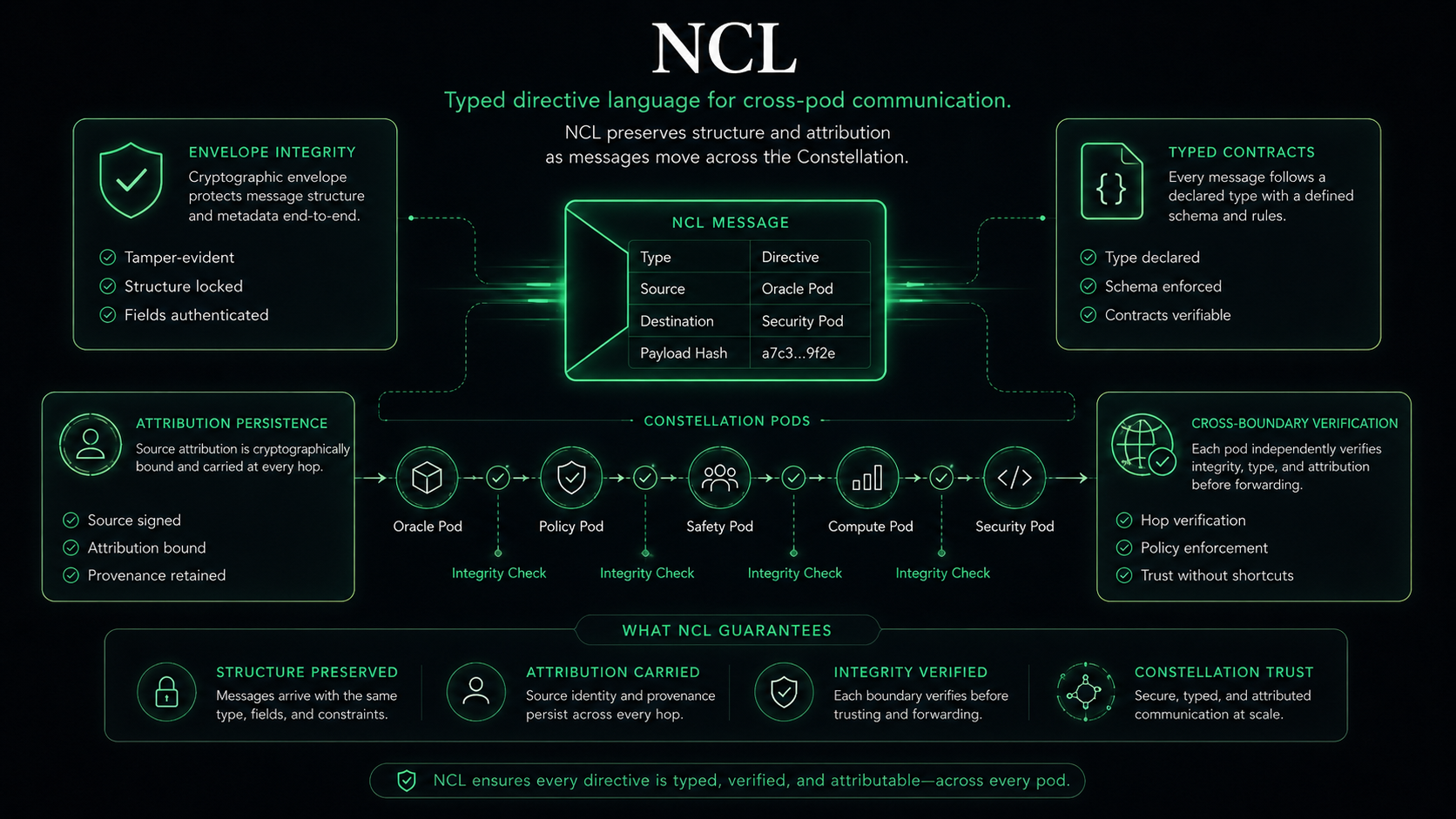
NCL

NCL is the typed directive language used across the Constellation for cross-pod communication. Every instruction, query, and response travels through NCL — structured, attributable, and validated at the envelope level so commands cannot be silently malformed mid-flight.

NCL — typed directive language for cross-pod communication
Message structure

What It Is

When seven core lanes and thirteen specialist pods coordinate at runtime, the question of what they say to each other matters as much as what they think. Unstructured text exchange between agents is the easiest place for governance to fail: messages get reinterpreted, intentions get rephrased, attribution gets lost, and the audit trail becomes a guess.

NCL solves that by treating cross-pod directives as a typed contract. Every message carries explicit type information, source attribution, and envelope integrity guarantees. The Constellation can verify what was said, who said it, and whether the form was intact — without having to parse natural-language text after the fact.

U.S. PROVISIONAL APPLICATION (NUMBER PENDING)
NCL — Constellation Coordination Language
Typed directive language for cross-pod communication in governed multi-AI systems. Patent details to be added when filed.

Architectural Properties

Envelope Integrity
Each NCL directive is enveloped with type, source, destination, and payload-hash. The envelope cannot be tampered with mid-route without detection — the receiving pod knows immediately if the message it received is not the message that was sent.
Typed Contracts
Every directive type has a defined schema. A "query" looks different from a "command" looks different from a "verdict." Pods can refuse messages that don't match the expected type for the channel — structural discipline at the protocol layer, not just in application code.
Attribution Persistence
Source identity (which lane, which actor, which session) travels with every NCL message and is preserved through the audit chain. Lost attribution is detectable and refused; no message is ever processed without a known source.
Cross-Boundary Verification
Bob (the substrate state machine) carries NCL across pod boundaries with the envelope integrity check applied at each hop. Combined with Layer 4 Obelisk's content verification, NCL provides defense in depth at the protocol layer.

How It Fits Into the Stack

NCL sits between the lanes and Bob. Lanes produce NCL messages; Bob routes them; Layer 4 verifies the content within them; CCW logs the whole exchange to the audit chain. The four components work together: HyperNet SDC provides the substrate, Bob provides the coordination, NCL provides the language, Layer 4 provides the content verification, and CCW provides the operator surface.

Without NCL, the Constellation would have to trust unstructured text exchange between agents — a category of risk this architecture is specifically designed to eliminate.

Relationship to Other Components

HyperNet SDC is what NCL runs on. Layer 4 Obelisk is what NCL passes through. CCW Platform is what orchestrates NCL traffic. The Constellation is who speaks NCL. Each layer has its own job; NCL is the grammar.

For collaboration inquiries or to discuss the NCL specification — reach out.