Platform overview
CCW Platform
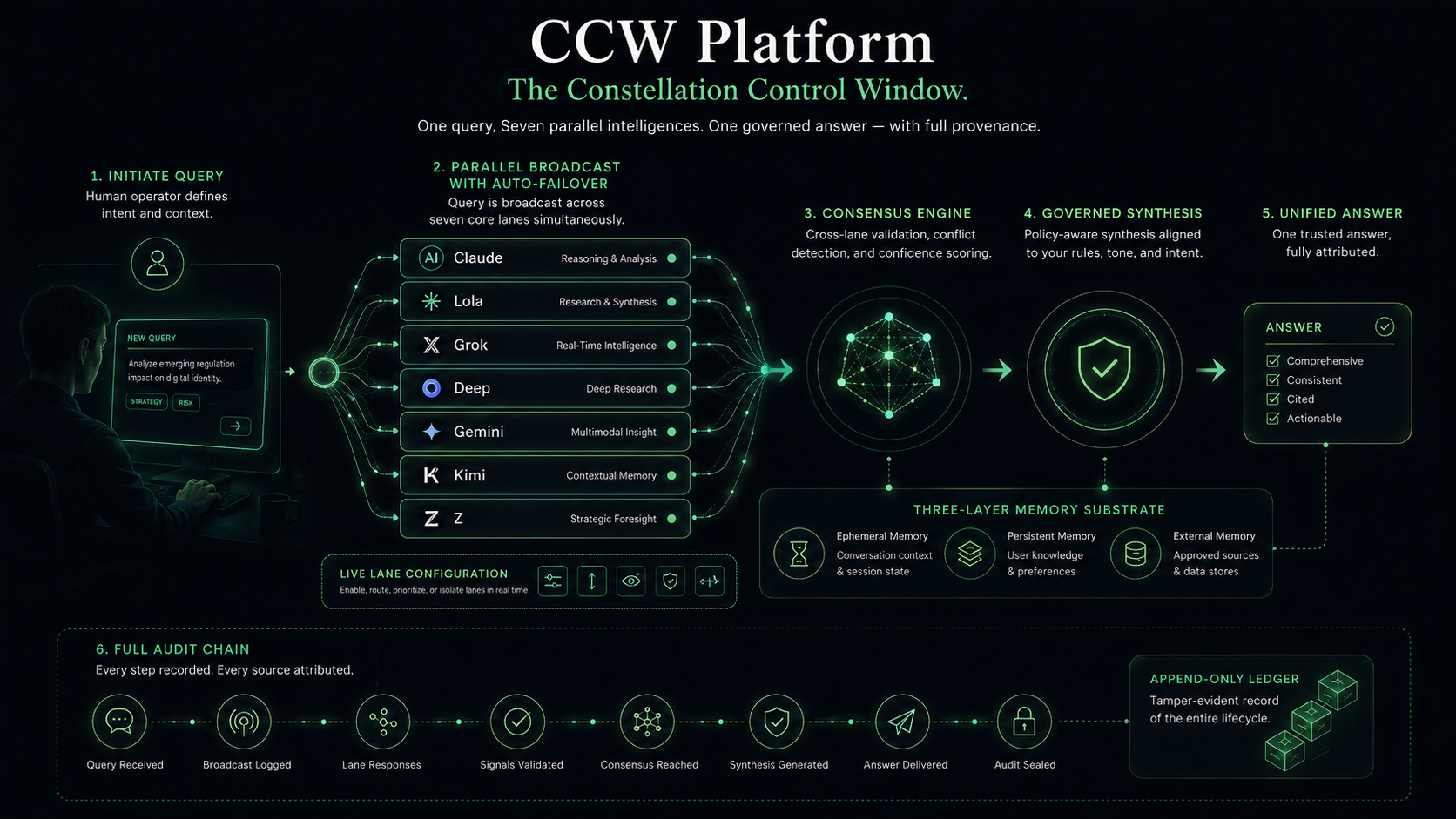
The Constellation Control Window: the operator platform that runs the constellation. Multi-lane broadcast, consensus scoring, governed synthesis, hot-swappable models, full audit chain — all of it observable, all of it under human authority.
What It Is
CCW is the operator surface and orchestration engine for the constellation. It's where a query becomes a parallel broadcast across seven core AI lanes, where the responses get scored for consensus, where dissent gets preserved when it matters, and where the unified synthesis lands on the operator's screen with full attribution back to the source lanes.
Architecturally: FastAPI backend, vanilla-JS operator UI, JSONL audit chain, config-driven model routing, and a four-level synthesis fallback that degrades gracefully when any single model fails. The whole thing is built so a human operator can see what's happening, understand why, and intervene at any layer.
The Seven Core Lanes
Each query broadcasts in parallel to seven AI lanes from seven different vendors. Per-lane primary, fallback, and emergency models are configured separately; failover is automatic with circuit-breaker cooldown after consecutive failures.
| Lane |
Provider |
Role |
| Claude | Anthropic | Structure / Ethics / Guardrails |
| Lola | OpenAI | Relational Integration |
| Grok | xAI | Disruptive Ideation |
| Deep | Together AI / DeepSeek | Long-Horizon Analysis |
| Gemini | Google | Pattern Synthesis |
| Kimi | Moonshot AI | Context / Memory |
| Z | Zhipu AI | Agent Operations |
Plus thirteen specialist pods (legal, health, finance, research, hazops, deep space, marketing, landman, chargeact, relay, scout, BIAB, coding) — see The Constellation for the full roster.
Core Capabilities
Routing
Parallel Broadcast with Auto-Failover
Every query fans out to all active lanes simultaneously. Each lane has a configurable primary / fallback / emergency model. Three consecutive failures trip a per-lane circuit breaker; the lane reattempts after a cooldown. The operator sees per-lane status in real time.
Scoring
Consensus Engine
Per-query consensus score between lane responses. High agreement triggers Catfish review for groupthink risk. Low agreement preserves dissent in the synthesis rather than averaging it away. The Lola Rule applies: every specific claim is tagged VERIFIED, APPROXIMATE, or HYPOTHESIZED.
Unification
Governed Synthesis
Four-level fallback synthesis: a primary synthesizer (Claude), a secondary (OpenAI), a deterministic rule-based merge, and finally explicit CPN escalation when automated synthesis cannot complete honestly. Every output carries the fallback level it used — the operator knows whether they got an LLM synthesis or a degraded path.
Hot-Swap
Live Lane Configuration
Lane models, endpoints, and trust levels are config-driven and live-editable through an authenticated API. Every swap requires a reason (≥ 10 characters, written to the audit chain) and writes a dated note into the lane configuration. No silent reconfiguration.
Memory
Three-Layer Memory Substrate
The Constellation Memory System: an Atomic layer for raw facts, an Epistemic layer for interpretive variance and dissent, and a Constitutional layer for sovereign decisions. Append-only by construction. Memory becomes institutional intelligence — the system remembers not just what it concluded, but how.
Audit
Full Decision Provenance
Every query, swap, escalation, and synthesis is logged with full context — session, lanes succeeded, consensus score, fallback level, latency, model diversity warnings. JSONL audit chain with daily rotation. Cryptographic chain hash forthcoming.
The Alignment Layer (Dormant)
CCW includes a scaffolded but dormant Alignment Layer — a system firewall designed to anchor every input before any pod reasons on it. The scaffold is fully built (Light Guard inline, Heavy Guard skeleton, structured verdict objects, persistent anchor chain in Tier 3 memory). The enforcement flag is off by design.
The Alignment Layer activates only after explicit ratification by the human Central Processing Node and at least three approving AI lanes. Until then, the pipes are in but the pressure is off. This is deliberate. Constitutional Safeguards govern what the layer is allowed to do when it does activate.
Current state: Alignment Layer scaffold ratified (SOT v0.4.3, May 19 2026). Implementation Plan v0.6 approved. Flag remains false — pure pass-through. Seven open questions are under rotation review before the flag flips.
Architecture Map
CCW sits in the middle of the stack. Below it: HyperNet SDC provides the hardware-anchored substrate that proves the integrity of where the compute ran. Above it: the seven core AI lanes plus thirteen specialist pods, coordinated through a human Central Processing Node. The CPN holds final authority on every decision the platform makes.
Operator interfaces include a hub dashboard, a query console, a lane rack with hot-swap controls, a lane configuration editor, and a dedicated alignment observability surface. Every screen is built to honor the Provenance Integrity Rule: the system's state is never invisible, and degraded paths are always named.
Status & Access
CCW runs in active research operation. The platform is the research instrument — published benchmarks, governance experiments, and ongoing publications all flow through the same code that operates the live constellation. We do not run separate research and production stacks; that would be a different kind of dishonesty than the one the architecture is designed to prevent.
Access is not currently public. Demonstrations, technical walkthroughs, and partnership inquiries are welcome — reach out.