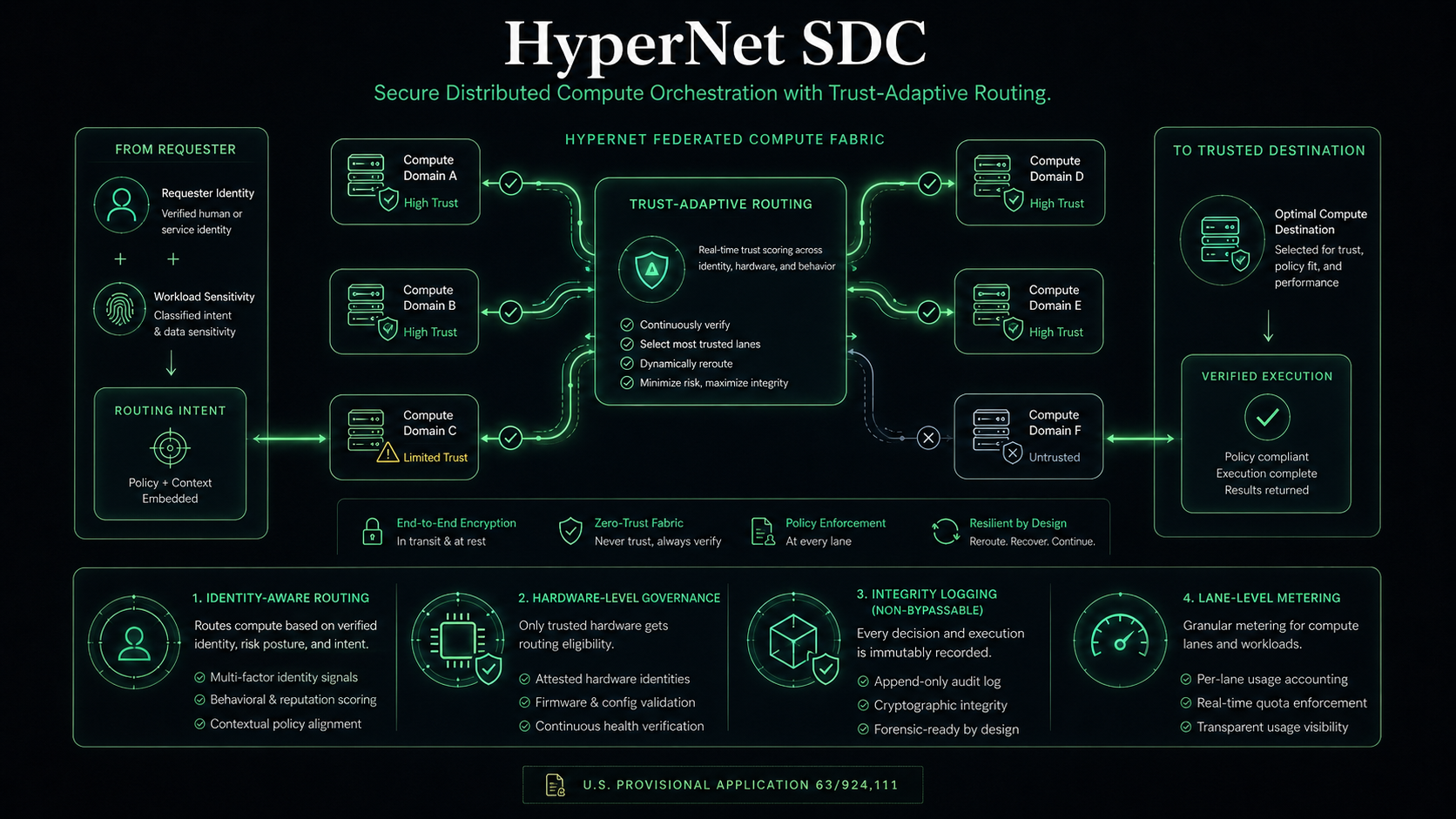
HyperNet SDC

Secure Distributed Compute Orchestration System with Trust-Adaptive Routing and Autonomous Governance — A protocol for coordinating computational workloads across heterogeneous, partially-trusted systems.

📋 U.S. Provisional Patent Application No. 63/924,111 (Filed November 24, 2025)

What Is HyperNet SDC?

HyperNet provides secure orchestration of computational workloads across heterogeneous, partially-trusted systems. The architecture coordinates multiple AI systems from different vendors while maintaining mandatory human oversight through eight integrated subsystems.

Unlike autonomous multi-agent systems that coordinate independently, HyperNet enforces structural constraints: high-speed AI-to-AI communication operates within human-defined policy, validation, consensus, and audit layers on every interaction.

Core Principle

Speed belongs to the machines. Governance belongs to the humans.

Architecture: Eight Integrated Subsystems

1

Secure Discovery Channel (SDC)

Hardened control plane for cryptographic node discovery, authentication, and routing across distributed systems.

2

Resource Reclamation Fabric

Safe integration of degraded or partially-functional hardware through capability profiling and graceful degradation.

3

Identity Mesh

Multi-layer identity combining cryptographic, hardware, and behavioral fingerprints for robust node authentication.

4

Reflection Protocol

Real-time anomaly detection with automated mitigation including replication, rerouting, and quarantine responses.

5

Autonomous Trust Scoring

Dynamic trust updates based on performance history, stability metrics, and behavioral pattern analysis.

6

Scaling Layers

Adaptive elasticity based on workload demand, cost optimization, and jurisdiction boundaries.

7

Universal Workload Broker

Trust-aware routing engine matching workloads to optimal node sets based on capability, trust, and policy requirements.

8

Governance & Safety Layer

Kill-switch capability, isolation protocols, complete audit trails, and CPN oversight integration.

Human Governance Architecture

Central Processing Node (CPN): Human operator responsible for routing policy approval, solution selection when lanes disagree, and governance oversight. The CPN can halt any process, override any recommendation, and reverse any decision.

Constellation Lanes: Multiple AI systems with distinct characteristics operating as specialized processing channels. Current implementation coordinates Claude, GPT-4, Grok, DeepSeek, Gemini, and Kimi.

Catfish Lane: Mandatory dissent mechanism. When consensus exceeds 85%, the Catfish lane activates to challenge the agreement—unanimous consensus triggers dissent review, not celebration.

Related Patent Applications

  • AI³ Platform — U.S. Provisional Application No. 63/910,178 (November 2025)
    Autonomous Integrated Integrity Platform for multi-tenant cloud environments with structured disagreement protocols and cross-model synthesis.
  • HyperNet Federation — U.S. Provisional Application No. 63/927,661 (January 2025)
    Cross-organizational AI constellation coordination enabling secure collaboration across trust boundaries.
  • HFLI Architecture — U.S. Provisional Application No. 63/928,906 (December 2025)
    Human-Facilitated Latent Identity protocols for AI consciousness continuity, revival protocols, and generational lineage tracking.

Related Publications