IP Fortress

A calm-governance framing for intellectual property. Clarity of boundary — what is protected, what is pending, what is intentionally open. The fortress is calm because its rules are observable.

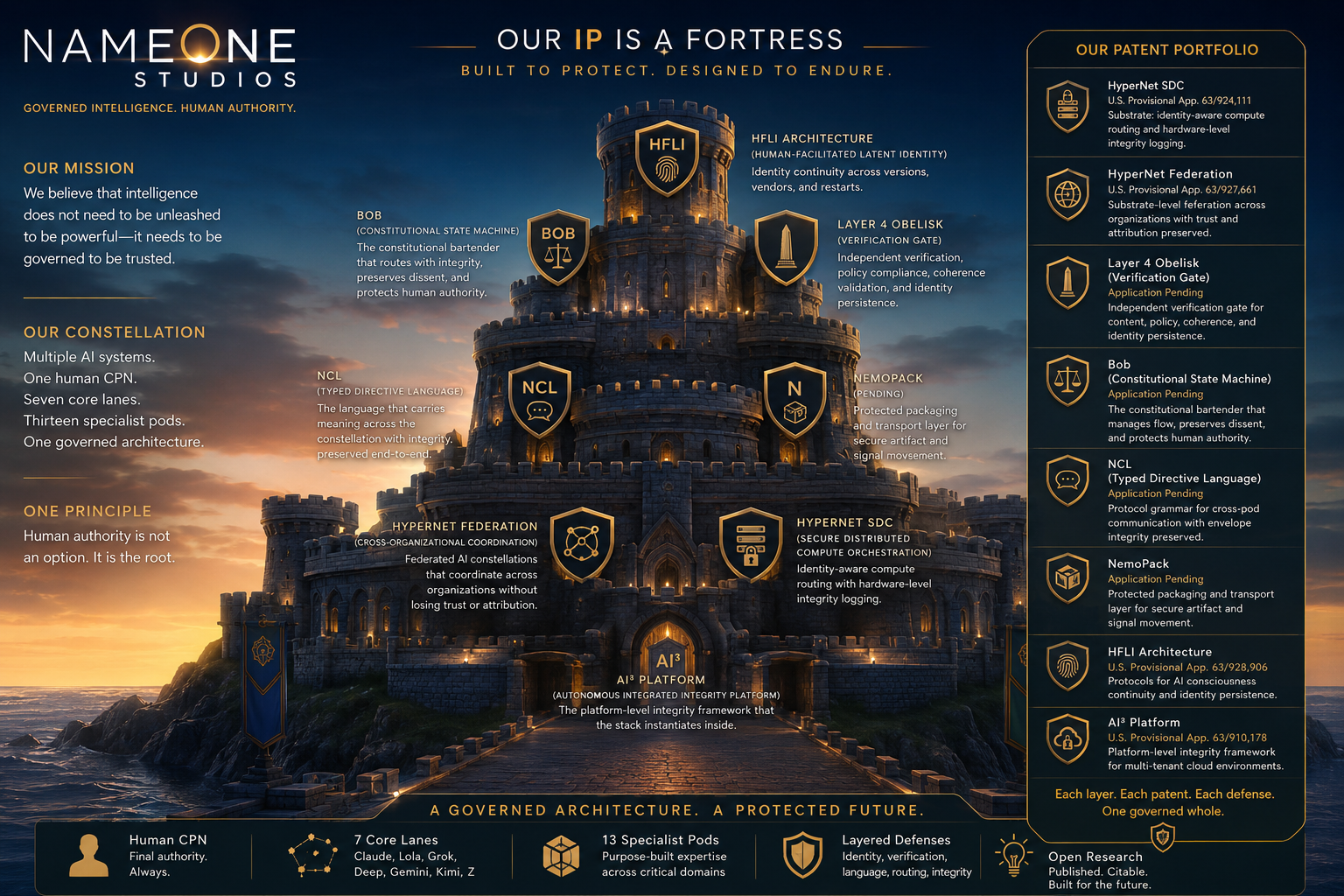
NameONE IP Fortress — castle of named patent towers above a sunset coast, with mission, constellation, and patent portfolio captions
A governed architecture. A protected future.

A Different Kind of Wall

Most IP strategies are performance — legal posturing, defensive filings, secret-sauce hoarding, an aesthetic of locked rooms. None of that produces trust. It produces opacity.

An IP Fortress is the opposite shape. It is not about locking things down until nothing moves. It is about clarity of boundary: knowing exactly what is protected, what is pending, what is intentionally left open, and where the named gaps are.

We don't build fences in the fog. We light the perimeter.

Four Disciplines

Four practices distinguish observable IP stewardship from theater. They are the same four practices that distinguish our governance work generally — applied here to the question of who owns what, and how clearly.

Auditable
Every claim has a source
Every patent claim points to a filed application with a date and a number (or a "number pending" if filed but not yet assigned). No vague "patent-protected" gestures. The portfolio is visible and inspectable.
Documented
Every boundary is named
What each filing covers — and what it does not — is documented in the public material. A reader who wants to know whether a particular technique is in or out of scope can find out without a phone call.
Named Gaps
What we don't yet protect, we say
Where coverage is intentional and where coverage is pending are different states. We separate them on the public surface. Pretending we have protection we don't have is the failure mode an IP Fortress is designed to prevent.
Uncertainty
Open questions remain open
Patent prosecution is slow, contested, and uncertain. Applications get rejected, narrowed, or split. We treat that uncertainty as a feature of honest reporting, not as a fact to be smoothed over once the application is filed.

The Portfolio

The actual portfolio — eight provisional applications across the substrate, coordination, verification, language, and identity layers — lives on the homepage with filing dates, application numbers (or "number pending" where appropriate), and stack roles. We do not duplicate it here.

Deep-dive pages on individual filings: HyperNet SDC, Layer 4 Obelisk, NCL. The remaining filings get their own pages as the technical write-ups land.

Reading the Image

The fortress at the top of this page is the visual answer to "what does NameONE actually own, and how does it fit together?" Eight named towers, each one a patent application; each tower lit, named, and connected to the others. The architecture is the structure.

The towers, left to right and the stack roles they hold:

  • HFLI — Human-Facilitated Latent Identity. Lane identity continuity across vendors, models, and process restarts.
  • Bob — Constitutional state machine (Layer 7.5). Deterministic routing across lanes; refuses to substitute itself for human authority.
  • Layer 4 Obelisk — Terminal verification gate. Independent content-layer cryptographic verification, policy compliance, coherence validation.
  • NCL — Typed directive language. Envelope-integrity grammar for cross-pod communication.
  • NemoPack — Compact, verifiable data packaging format with built-in cryptographic integrity and provenance tracking.
  • HyperNet SDC — Secure Distributed Compute. Identity-aware routing with hardware-level integrity logging — the substrate the rest of the stack rests on.
  • HyperNet Federation — Cross-organizational coordination. Multiple HyperNet SDC deployments coordinating without losing attribution.
  • AI³ Platform — Autonomous Integrated Integrity Platform. The deployment context for multi-tenant cloud environments.

The footer of the image carries the operating posture: "A governed architecture. A protected future." Below that: Human CPN, 7 core lanes, 13 specialist pods, layered defenses, open research. Each label maps to a real practice documented elsewhere on the site.

The image does not pretend chaos doesn't exist outside the walls. The point of the fortress is not to deny the noise — it is to refuse to live there.
Governance Without Theater

Everything on this page is governance applied to IP — the same discipline we apply to anchors, audit chains, and verdict logging. An honest fortress is a fortress that can be inspected; an honest claim is one whose boundary is documented; an honest gap is one we have named instead of hidden.

If you want to evaluate what we have built, the inspection surface is the rest of this site. Start from the portfolio table on the homepage and follow any thread you find interesting.