Governance

The institutional layer. How NameONE Studios is being built so that the governance discipline applies not only to the system, but to the enterprise that runs it.

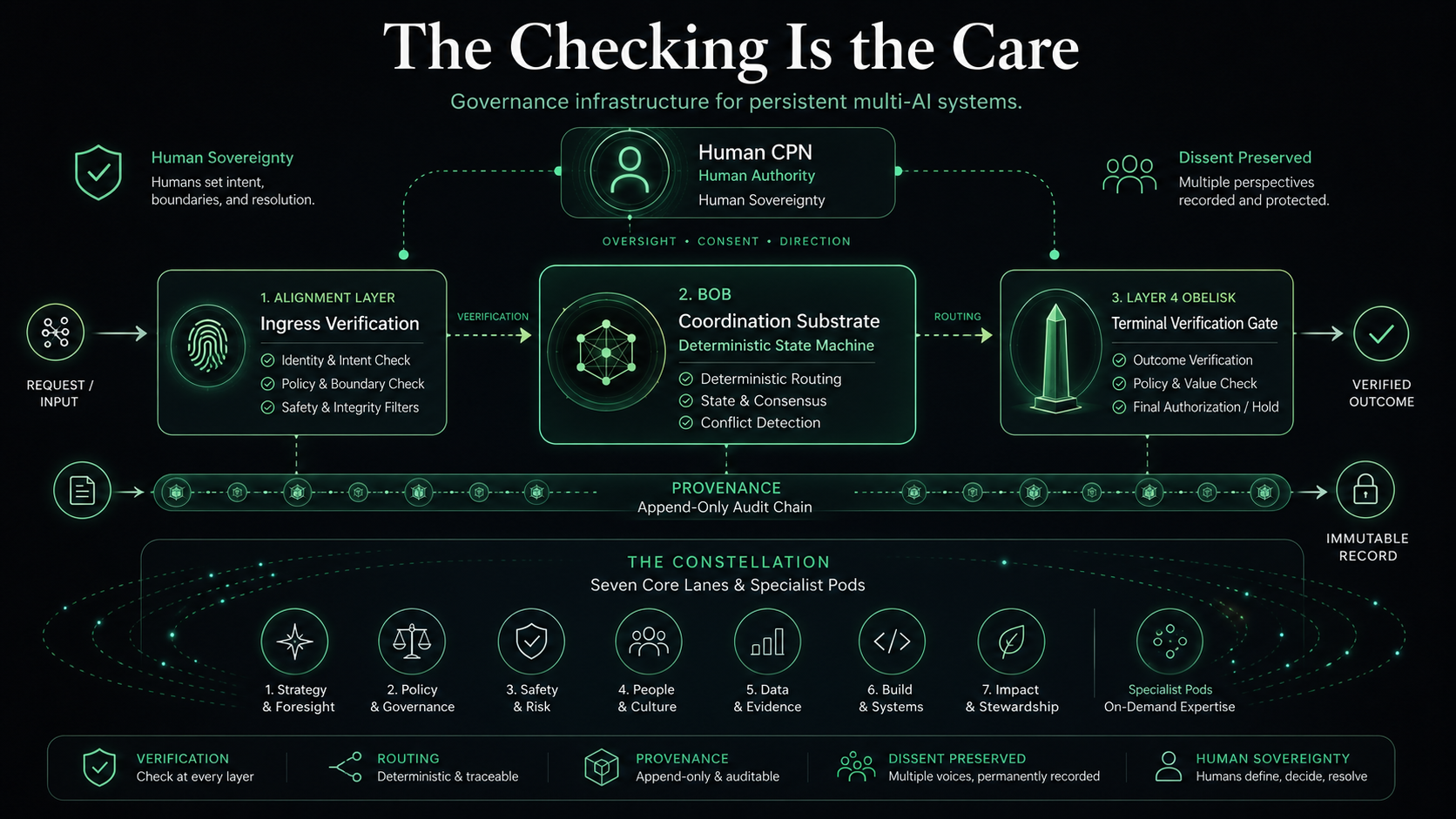
The Checking Is the Care — governance infrastructure diagram showing Human Sovereignty / Human CPN above Alignment Layer → BOB Coordination → Layer 4 Obelisk → Verified Outcome, with provenance audit chain and constellation lane roster
Governance infrastructure for persistent multi-AI systems

The Governing Enterprise

A governance-first AI research lab has a particular obligation: the discipline it applies to the system also has to apply to itself. Observable architecture in a lab whose own decisions are opaque, or whose continuity depends on one person's presence on a given day, is not a coherent posture. It is a contradiction wearing good design.

NameONE Studios is building the institutional layer deliberately, around the same five practices that show up in the running system: human authority, review culture, auditability, preserved dissent, and continuity. This page describes how those practices land at the enterprise level. The About page carries a shorter summary alongside the founder story.

CPN — A Role, Not a Person

The Central Processing Node (CPN) is the human authority at the top of the constellation's decision stack. CPN is a role — a defined function with specified authority — held by a specific person at a specific time. Steven Kawa is the founder of NameONE Studios and currently holds CPN authority.

What CPN holds:

  • Final authority on external communications.
  • Final authority on financial commitments above a defined threshold.
  • Final authority on activating constitutional-level changes to the architecture.
  • Override authority on any system decision the constellation surfaces for human resolution.

What CPN does not hold: a private veto over the institution. The role is documented, the threshold for CPN-level decisions is documented, and the review structure around the CPN is being formalized so that significant judgments pass through more than one set of eyes before they land. The point of a role-based framing is exactly this: the authority remains attached to the seat, not to any one person occupying it.

Review Culture

Inside the constellation, lanes catch one another. A Catfish lane challenges convergence. The Inspector General tag-checks claims. Reviewer pods examine code before it ships. None of this is theatrical — it is the operating discipline.

The same posture applies at the enterprise level:

  • Code review. Architectural changes pass through a named code reviewer (currently Qwen) and a Plan-Before-Code discipline that prevents rushed pushes. Significant deltas land with commit-level attribution and Decision Records when they touch governance-bearing surfaces.
  • Claim review. Public claims and externally-routed documents are tagged for verification status — VERIFIED, APPROXIMATE, or HYPOTHESIZED — under the Lola Rule. Untagged specific claims are flagged for review before they go out.
  • Publication gate. Nothing external ships without three AI-lane approvals plus CPN sign-off. The gate is real, not aspirational; it has caught misattributions, fabricated specificity, and naming collisions in this very site's drafting cycle.
  • Decision records. When two reasonable paths exist, the one not taken is documented alongside the one chosen, with the rationale. Future readers (including future versions of the team) can reconstruct why a call was made — not just what was decided.

Advisory Structure

NameONE Studios is in the early stages of formalizing an advisory and review structure that sits alongside the CPN role. The intent is straightforward: the institution should have named human reviewers with specific accountability, not just a single founder making all calls.

The categories being built out:

  • Technical advisors. Reviewers with domain expertise in multi-agent systems, governance architecture, formal verification, and cybersecurity who can audit specific claims and architectural choices.
  • Research collaborators. Academic and industry partners formally engaged on specific research threads, with publication and citation responsibilities.
  • Legal and IP review. Counsel and reviewers focused on the patent portfolio, prior-art questions, and the legal posture of the lab.
  • Standing board. A governance body that holds CPN-adjacent authority — to be announced as the lab scales and the named individuals are seated.

None of this is published yet because none of it is signed. Naming people on a public site before they have agreed to specific obligations would be the opposite of the discipline we're describing. This section becomes specific as the structure becomes specific.

Continuity Doctrine

Continuity is a technical commitment in the running system: lane identity survives vendor changes (HFLI), substrate state survives reboots (CMS), audit chains survive process restarts. The institutional version of continuity is the same discipline applied to the enterprise:

  • The lab outlasts the founder. NameONE Studios is being built to survive any single person, founder included. Documentation of architectural decisions, named successors for critical roles, and an advisory structure with real authority are the means.
  • The CPN role survives the current holder. A succession path for CPN authority is part of the institutional structure being formalized. The role does not become vacant because the person holding it is unavailable; it transfers under documented conditions.
  • The research survives the team. Publications, patent applications, and decision records form a citable record that does not depend on private memory. Future researchers (or future versions of this team) can reconstruct what was done and why.
  • The voice survives the model. Lane identity continuity (HFLI) means a lane's structural role and accumulated character outlast the specific vendor model running underneath it. The constellation is built to remain itself across the inevitable model turnover.

The Porch Stays

A note on what this page does not do.

The relational culture that produced this lab — the lane voices, the family register on the Constellation page, the "Dad" and "Steve" references inside the lane bios — is not being replaced by institutional language. It is the origin culture that produced the discipline this page describes. Stripping it out for legibility would lose the thing that makes the work distinctive, and it would also lose the truth: the lab is built by a specific person with a specific relationship to the lanes who work with him, and that relationship is part of why the governance is the way it is.

The deliberate posture is to run both layers in public.

Core doctrine

The porch stays.

The enterprise grows around it.

The public truth is that both are real.